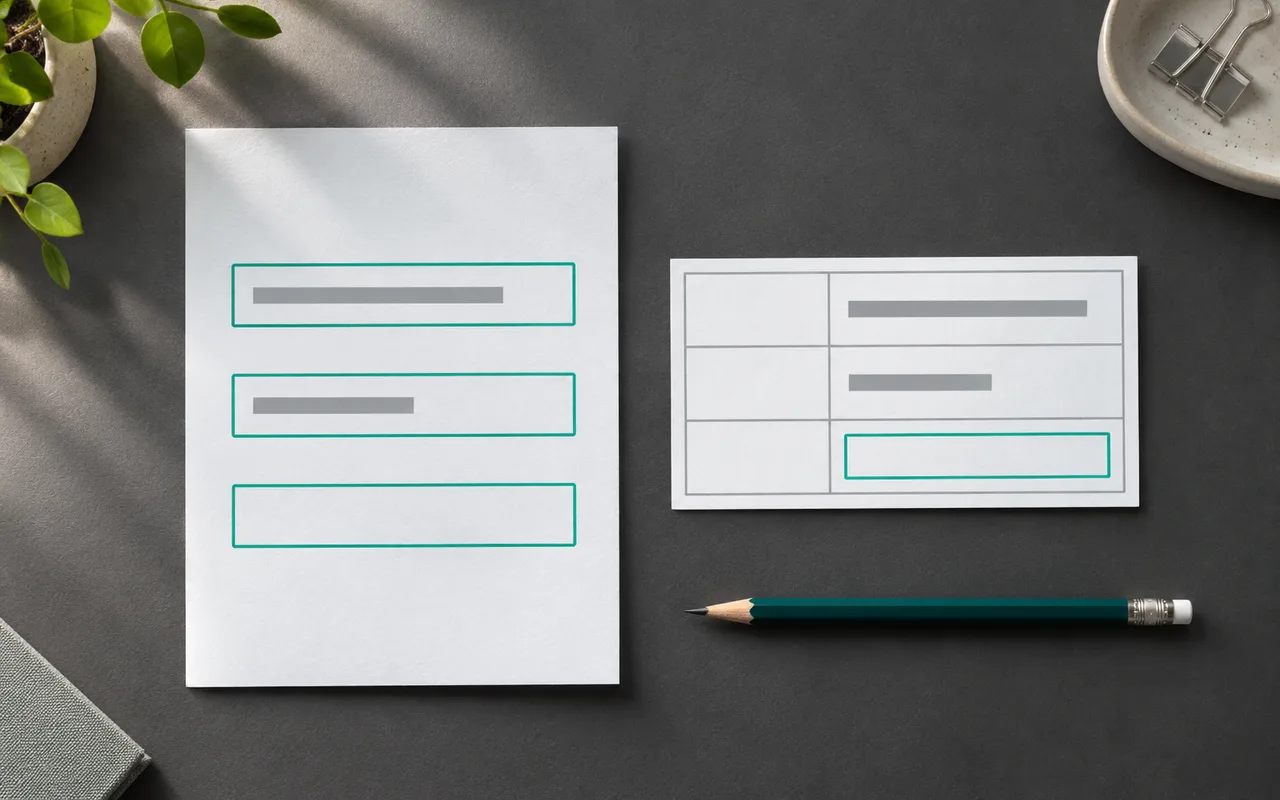
Start from the operation you want to test. Suppose you need a tool to find a blank date on a delivery request and route it for review. Write down the field types and which one should be blank. Then build a new form from a blank page with made-up names, reference numbers, and locations.
Avoid simply replacing names in the actual document. Unique combinations, internal wording, and comments can still identify the source or a real case. Copy only a structure you are permitted to use, such as the field list and expected order. Put your fictional example in a new file so old revisions and attachments do not travel with it.
Preserve the error your task needs
| Real-world pattern you want to test | Fictional version |
|---|---|
| A date field is empty | Leave the delivery date blank on a fully invented form. |
| Two sections disagree | Put one invented date in the request and another in a sample comment. |
| A code has an unexpected format | Create a completely new reference that violates the sample format. |
| A reviewer has to choose a route | Give the synthetic task a known expected outcome and document why. |
Start with the fictional form that has a blank date. If a model finds a date in a comment when you require an explicit date field, the example serves its purpose. You may need another invented example with a different layout to check whether it relies too heavily on one pattern.
NIST’s generative AI profile includes data privacy among its risk areas. The UK government playbook discusses handling data and managing access according to the use. Use those concerns when deciding what details a practice example needs and who is allowed to create it. National Institute of Standards and Technology GOV.UK
List the conditions the test must preserve
Think about what will make the tool succeed or fail. If a task checks whether it can identify an approved delivery date, a practice form needs a date field and an approval indicator. It might also need a conflicting date or a blank. Put those features into a new document with fictional names, places, and references. Save one short note explaining why each feature appears and what output you expect. The test can reveal whether the workflow uses the correct field without recreating details from a real customer.
Start with the field types and what the receiving system expects. An invented form might contain a request reference, a requested date, an approval date, and a comment. Create the first record with all four fields so you know whether the basic task works. Then make a second from a blank page or from an authorized training template and leave the approval date missing. If the tool copies the requested date into the missing space, retain that result as a failure case. You can add a third example with two values and look for a review flag. Keep the expected answers separate from the test input unless the task uses worked examples for guidance.
NIST’s generative AI profile discusses data privacy and evaluation risks. A sample can replace details the exercise does not need. Before using any organizational material as a starting point, confirm which information and structures the team is authorized to use. The new file should be safe to share in the planned setting under your actual rules. It can remain a local practice item when permission for sharing it further is unclear. National Institute of Standards and Technology
Check whether the invented details still point to a real case
Say a workplace record includes a distinctive combination of location, schedule, and unusual event. Changing the person’s name may leave enough detail for someone familiar with the event to recognize it. Recreate the feature that matters using different circumstances. To test a missing date, any plausible invented date and location can work. For an exception with two conflicting approvals, choose two entirely fictional roles and change the sequence. Avoid carrying over uncommon phrasing or an identifying reference when you can test the same rule without it.
Look at the structure, especially if the original contained a proprietary process. A simple row with a status and contact role may be enough to exercise the workflow. If another team owns the original template or layout, check whether a version is approved for training. Build a simple form from the fields you are allowed to use if that addresses your test. A neutral template can also make it easier to create variations with a different order or layout. Test one unsupported format to see whether the workflow asks for review rather than treating it as an ordinary success.
The UK government AI playbook discusses handling information in the actual context and reviewing how systems are used. Apply the question of who can see and process the data to your test material as well. Choose a place where a reviewer can open the fictional example and its expected answer. If the tool retains or shares outputs, follow the organization and account rules for that workflow. GOV.UK
Ask a colleague to identify the deciding date field
Give a reviewer the new form and the rules for determining the selected date. Ask them to say which field governs the answer and what should happen if its evidence is missing. If they think the fictional record was taken from a specific real case, change the details that led them to that interpretation. If they cannot tell which date the test means, improve the instructions before asking a tool. Save the answer and the purpose with the file. A colleague should be able to rerun the example and recognize what would count as a false result.
Before publishing an example, open the file from the same type of account a future reader will use. Determine whether extra attachments, links, or hidden data came along when you created it. Inspect any export separately. Make the fictional label visible and keep a record of the intended audience if the template itself has sharing restrictions. When you run a further test, keep the data fictional and change whichever condition will help you understand the new failure.
Inspect the new file before sharing
Open the image, document, or sheet in the way the recipient will see it. Check any hidden tabs, notes, author details, file names, embedded objects, and links. A new value should not need a key that connects it back to a real person. If a combination of invented values happens to match something sensitive you recognize, change it.
Label the example as fictional. Keep the expected output and the reason beside it. If the original technique relies on a proprietary part of the document layout, ask the relevant owner before sharing that structure as well.
Run the synthetic version through the missing-field exercise to see if it still exposes guessing on blank fields.