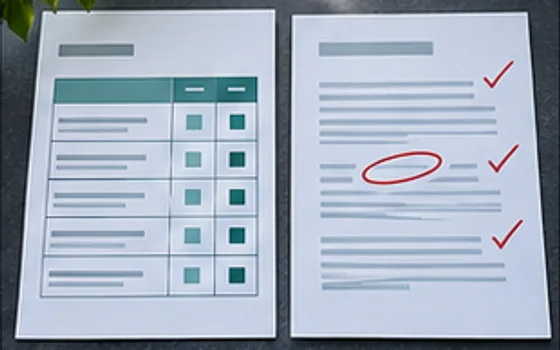
Give both tools the same task and make sure you can tell what a good result looks like. If the task is to extract approved meeting decisions, prepare notes containing a clear decision, a proposal that remains open, and an ambiguous action owner. Write the expected output yourself before looking at what either tool produces.
Pick a small test set that reflects the tasks you actually receive. Include routine inputs and a few cases with costly mistakes. Avoid using private records unless the tools and account arrangements are approved. Invented examples can expose useful differences before you decide whether a real-data test is needed.
Score the outputs the same way
| Check | Example rule |
|---|---|
| Accuracy | Every date and commitment matches the supplied notes. |
| Completeness | The draft includes each confirmed decision that affects the next work. |
| Uncertainty | Open issues remain visibly open. |
| Review effort | A person can locate the supporting passage quickly. |
Use identical task instructions where the tools permit it. Record versions and settings if they affect the result. Give each output a number and withhold which tool wrote it during initial scoring if practical. Large differences between reviewers are a sign that the criteria need clearer examples.
NIST’s generative AI profile discusses evaluation and documenting measurements. Capture which input caused a costly failure and how it was detected. A satisfactory average can hide a recurring error that matters for one duty. National Institute of Standards and Technology
Write the correct result before either tool sees the examples
Think of a question your team needs to answer repeatedly. If the task is recording meeting decisions, use cases with agreed dates, dates still proposed, and a discussion where nobody owns the next action. Use invented material or permission-appropriate records. Write the expected result with a quotation or source location supporting it. Share the same initial information with both tools where they have comparable access. A model allowed to retrieve other files might be doing a different version of the task, so record how its inputs differ.
Give the result a clear scale. A decision with a wrong deadline might fail the critical check even when every title and speaker name is correct. An output with a formatting problem could still preserve every fact. Write the difference into the rubric before inspecting the results. A reviewer should be able to tell whether the system supplied a fluent summary that promoted a suggestion into a commitment. Mark that type of mistake near the expected answer. If the task leaves a proposed decision open, the expected result can retain its uncertainty so both tools are judged consistently.
NIST’s generative AI profile discusses measuring performance in context and documenting tests. Keep your instructions, settings, and input version with the output. If the provider changes the model or your organization changes the tools it can use, the next run can start from the same material. Label the test scope and check which details a reviewer should verify before recommending the tool for a live process. National Institute of Standards and Technology
Inspect a numerical comparison without overreading it
Imagine a test with ten example decisions. Tool A gets eight right, while tool B gets seven right. If one of A’s two errors would present an invented deadline to a customer and all three B mistakes are repairable wording omissions, the raw scores do not supply the whole decision. List which failures would need someone to stop and check the source. A useful review may end up using one tool for formatting and keeping the existing process for communicating deadlines. The examples here are hypothetical and cannot estimate performance on other meetings.
Check which cases were represented. If nine examples follow the same clear template and one contains ambiguity, you have little evidence about common edge situations. Add another small set for missing dates, cross-team ownership, or mixed proposals and decisions. Mark expected behavior in each. The reviewer can record which cases change their scores and whether the difference matters to the task. Keep a few new cases for verifying a change before testing again. An example used to design the prompt can help you debug it. A fresh example shows what happens beyond that earlier adjustment.
The Harvard Business School AI Institute describes an experiment where assistance affected tasks differently. Look for your own evidence when deciding what to try next. Label the examples by work type and report which one showed the important failure. A small result may support a supervised trial for extracting confirmed decisions from clear notes and leave review of incomplete discussions with a person. Record the relationship between that decision and the test you actually ran. Harvard Business School AI Institute
Tell the next reviewer what would invalidate the comparison
Suppose one tool’s configuration changes between two sessions. The reviewer can retest the same inputs with the current version and document which results moved. If another tool handled a different file format, decide whether you want to compare platforms under realistic conditions or isolate one common capability such as understanding text. Give the results a scope that shows which choice you made. A report comparing everything can obscure a critical dependency such as the ability to read attachments.
Review a disputed output with another person. Ask them to find the exact issue and place it against the scoring rule. If they disagree because the rule is unclear, update the expected case before comparing both again. Record which error would stop the team from using the tool and who can approve the next test. Retain a short set of examples and notes that lets another person reproduce the decision when the task or tool changes.
Look at the differences by task
Research summarized by the Harvard Business School AI Institute describes differing outcomes across tasks within one experiment. Inspect scores by task before you look at an overall average. You might choose a tool for summarizing straightforward notes and use manual reading where the source is ambiguous. A small test can support a limited trial under review. Harvard Business School AI Institute
Add new test cases when you find an error that was missing from the original set. Keep the old cases so you can see whether a fix changes previously good behavior. Decide what would make a version unacceptable before a team starts using it more widely.
Apply a short evidence and completeness rubric to the drafts from both tools before you inspect which tool produced them.